How to Choose a Bean-to-Cup Coffee Machine
Choose a bean-to-cup coffee machine around your daily drinks and preferred milk routine. Then compare grinder controls, cleaning access and counter space before paying for extra recipes or user profiles.
On this page (10 sections)
- What should you look for in a bean-to-cup coffee machine?
- How much drink choice do you need?
- Should you choose a manual or automatic milk system?
- Which of these bean-to-cup machines fits your routine?
- How should you use the grinder and coffee controls?
- Will a bean-to-cup machine fit your counter?
- What should you do during initial setup?
- How can you compare machine cleaning routines?
- Which buying and use mistakes should you avoid?
- How do you choose your bean-to-cup coffee machine?
Choose a bean-to-cup coffee machine by matching your usual drinks and milk preparation to the controls you'll use every day. Then check cleaning access and counter space before choosing extra recipes.
For daily cappuccinos, automatic milk preparation can be worth more than a large drink menu. For black coffee with an occasional latte, a simpler machine with a manual frother may suit you better.
Our super-automatic espresso machine buyer guide explains the wider category. Here, the focus is choosing between features that change your morning routine.
What should you look for in a bean-to-cup coffee machine?
Start with drink choice, milk preparation, cleaning and physical fit. Use those needs to narrow the field before comparing extra controls.
Write down what each person in your home drinks during a normal week. Separate daily needs from drinks you might make only when guests visit.
| Decision | What to check | How to choose |
|---|---|---|
| Everyday drinks | Named recipes and serving controls | Cover your regular drinks first |
| Milk preparation | Manual frother or automatic system | Match the work to how often you make milk drinks |
| Personal settings | Strength, volume and user profiles | Favor profiles when people want different versions of the same drink |
| Grinder | Adjustment options and instructions | Choose controls you're willing to learn |
| Care | Milk parts, brew group and descaling | Read the cleaning steps before buying |
| Fit | Body dimensions and access space | Allow room to refill, empty and clean |
A long menu earns its place when people actually use it. Several similar milk recipes may matter less than quick access to your preferred coffee strength.
Which bean-to-cup coffee machine features matter most?
Milk automation matters most for frequent milk drinks, while coffee controls matter more for espresso and black coffee. Shared households should also consider how often users would need to change each other's settings.
Profiles become useful when 2 people both order a latte but want different amounts of coffee or milk. A solo drinker with one favorite recipe has less need for separate saved settings.
Decide how much involvement you want, too. Our automatic vs semi-automatic espresso machine comparison helps if you would rather control preparation more closely.
How much drink choice do you need?
Choose a machine that makes your regular drinks with few extra steps. Count the drinks you'll use, rather than treating the largest menu as the best choice.
An espresso setting makes a small, concentrated drink. An Americano adds water to espresso, while a machine's coffee setting can use a different brewing program from either espresso or drip coffee.
If you prefer a large mug, check how serving volume can be adjusted. Simply pushing more water through the same coffee dose can produce a thinner, more bitter drink.
For milk drinks, distinguish a named automatic recipe from the ability to make that drink manually. A machine with a steam frother can help you make a cappuccino without having a cappuccino button.
For iced coffee, decide whether you want a dedicated program or are happy making coffee and adding ice yourself. Ice dilutes the drink, so brew strength and the amount of ice both affect the result.
Should you choose a manual or automatic milk system?
Choose automatic milk preparation for frequent lattes and cappuccinos. A manual frother suits occasional milk drinks and buyers who enjoy controlling that step.
With manual frothing, you prepare the milk separately and combine it with the coffee. This gives you a task to learn and repeat, especially when making several drinks in a row.
Automatic systems handle more of the milk preparation, but they still need care after use. Include that cleanup when judging how much time the machine will save.
Think about milk choice as well as drink choice. Dairy milk and plant-based alternatives foam differently, and changing the milk can change the texture even when the machine settings stay the same.
Use cold milk, start with a modest amount and clean milk-contact parts promptly according to the manual. Don't leave milk sitting in an attachment on the counter between widely spaced drinks.
Our Philips LatteGo guide explains another Philips milk system. The Philips 2200 model covered here uses a classic frother, so its preparation and care steps differ.
Which of these bean-to-cup machines fits your routine?
Choose the Magnifica Evo for daily automatic milk drinks, the Dinamica Plus for shared preferences, or one of the manual-frother models for a simpler coffee routine. Each makes sense for a different buyer.
These examples show where specific features help. They also show when a feature adds little to the way you drink coffee.
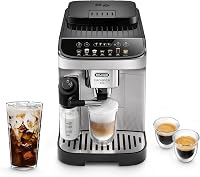
De'Longhi Magnifica Evo: for daily milk drinks
The Magnifica Evo suits someone who wants automatic cappuccinos and lattes without needing separate user profiles. Its 7 one-touch or customized options cover espresso, cappuccino, latte macchiato, iced coffee, coffee, hot water and My Latte.
The LatteCrema system textures milk and milk alternatives, and its milk container can go in the fridge between uses. My Latte lets you personalize and save your own recipes.
Its Over Ice program adjusts the dose and brew for iced coffee. That gives regular iced-coffee drinkers a dedicated starting point instead of relying only on a hot-coffee setting.
Choose it for a mix of hot milk drinks and iced coffee. Skip it if you mainly drink black coffee or need separate saved preferences for several people.
De'Longhi Dinamica Plus: for a shared household
The Dinamica Plus suits households where people want different drinks or different versions of the same drink. Its 24 one-touch or customized options include flat white, latte, espresso, cappuccino and iced coffee.
The profile system reduces the need to keep changing shared preferences. Smart One-Touch places frequently selected drinks first, which helps keep everyday choices accessible within the larger menu.
Its LatteCrema Hot System works with milk and milk alternatives, with light, creamy and dense foam settings. A 3.5 in full-touch color display provides access to drink selection and customization.
Choose it when saved preferences solve a daily problem. Skip it if one person makes the same black coffee every morning and has little use for milk settings or a broad menu.
De'Longhi Magnifica Start: for coffee first
The Magnifica Start suits buyers who want straightforward black-coffee choices and occasional manual milk preparation. It offers Espresso, Coffee and Americano, with adjustable intensity.
Its traditional frother handles milk and milk alternatives, so a latte remains possible without an automatic milk system. You do the milk step yourself rather than selecting a complete milk recipe.
This makes sense if weekday coffee is simple and milk drinks are an occasional extra. It also suits someone who wants to learn frothing without taking on manual espresso grinding and dosing.
Choose it for a short menu and manual milk control. Skip it if several daily cappuccinos would turn frothing into a chore, or if you want a dedicated iced-coffee recipe.
Philips 2200 Series: for basic drinks and accessible brew care
The Philips 2200 suits buyers who want espresso and coffee, adjustable strength and volume, and direct access to the brew group for rinsing. Hot water is also available.
It has a ceramic grinder and a touch display. The removable brew group can be rinsed under the tap, giving you a clear maintenance step to include in your routine.
Philips says AquaClean can allow up to 5,000 cups without descaling when filters are replaced as prompted. That claim depends on following the filter routine and does not replace everyday cleaning.
Choose it for adjustable basic drinks and a rinseable brew group. Skip it if automatic milk recipes or saved household profiles are central to your plans.
How should you use the grinder and coffee controls?
Start with the recommended settings and change one control at a time. Adjust strength and drink volume before making large grind changes.
The 3 De'Longhi machines above each use a conical burr grinder with 13 settings. That provides adjustment points, but the right position depends on your beans, serving size and taste.
Strength generally changes how much coffee the machine uses, while volume changes the amount of drink. Grind size affects how water moves through the ground coffee, so these controls solve different problems.
If a large coffee tastes weak, first try a smaller serving or a higher strength setting. Moving straight to the finest grind can create slow flow without fixing an oversized drink.
Follow the manual for when the grinder can be adjusted, and allow several drinks before judging a change. Our De'Longhi Magnifica grind-setting guide explains how to approach those adjustments.
Use beans suitable for your machine, and keep flavored or coated beans out unless the manual allows them. Our guide to coffee beans for super-automatic machines covers bean choice in more detail.
Will a bean-to-cup machine fit your counter?
Measure width, depth and height, then check how you'll refill and clean the machine. A body that fits beneath a cabinet can still be awkward to use there.
| Machine | Dimensions (D x W x H) |
|---|---|
| De'Longhi Magnifica Evo | 19.53 x 12.09 x 16.06 in |
| De'Longhi Dinamica Plus | 16.9 x 9.3 x 13.7 in |
| De'Longhi Magnifica Start | 19.8 x 11.81 x 16.14 in |
| Philips 2200 Series | 14.6 x 9.6 x 17 in |
Among these models, the Dinamica Plus has the narrowest body and lowest height. The Philips has the shallowest body, which may help on a less deep counter.
Those dimensions describe the machine itself. You also need clearance for bean filling, water access and removing waste containers, with the required space depending on how each part opens.
Mark the footprint with paper before ordering. Place your usual cup and milk pitcher beside it to check whether the whole coffee-making area will work.
Avoid a position where every refill requires moving the appliance. A convenient location makes routine care easier to keep up with.
What should you do during initial setup?
Set water hardness, rinse the machine and establish a baseline drink before changing several settings. Follow the model's first-use sequence rather than skipping straight to customization.
Start with these steps:
- Wash or rinse the parts identified in the manual.
- Check water hardness and enter the result where required.
- Prepare and activate a water filter if you're using one.
- Complete the required priming and rinse cycles.
- Add suitable beans and make a standard drink.
- Adjust strength or volume to suit your usual cup.
Keep a few notes while settling on your settings. Record the beans, drink size and strength so you can tell which change helped.
Use the same cup during this stage, and warm it if your drink cools too quickly. A large, cold mug can take heat from a small espresso before you've started drinking.
Avoid filling the bean hopper to the brim while deciding which beans you prefer. A smaller amount makes it easier to change coffee without mixing several varieties.
How can you compare machine cleaning routines?
Compare daily milk care, coffee-residue cleaning and scale removal separately. An automatic rinse handles only part of the work.
The Magnifica Evo and Magnifica Start have removable, dishwasher-safe parts, and the Dinamica Plus also has dishwasher-safe parts. Check the manual for exactly which pieces can go in and how they should be placed.
For everyday use, plan to empty the drip tray and grounds container, refresh the water and clean milk-contact parts. Rinse or clean the brew group only as directed for that model.
Our De'Longhi Magnifica cleaning guide gives a more detailed example. Choose a machine whose routine you can maintain on a busy weekday.
Descaling removes mineral buildup inside the water path. It is a separate job from washing coffee residue or milk from removable parts.
Use the correct descaler and follow the machine's prompts. Our guides to descaling the Magnifica and descaling the Dinamica explain those model-specific steps.
Budget for filters and cleaning supplies alongside the machine. A filter may change the descaling schedule, but it doesn't remove the need to clean milk parts, trays or coffee residue.
Which buying and use mistakes should you avoid?
Avoid choosing by recipe count alone or changing every setting at once. Both can leave you with more complexity without improving your daily coffee.
- Buying milk automation for rare use: A manual frother may cover occasional lattes while keeping your usual coffee routine simple.
- Expecting a drip-coffee match: Espresso-based coffee and drip brewing work differently, even when both fill a mug.
- Treating finer as always better: Very fine grinding can slow the flow; change it only as the manual directs.
- Ignoring milk cleanup: An automatic milk drink still leaves parts that need prompt care.
- Using one adjustment for every problem: Weak coffee, slow flow and a drink that cools quickly call for different checks.
- Measuring only the body: Cabinet clearance and access to removable parts affect daily use.
Also be realistic about serving a group. These are individual-drink machines, so several coffees mean repeated drink cycles and more attention to water and waste containers.
If your main need is a large pot for guests, consider keeping that task separate. Choose the bean-to-cup machine around the drinks you make most often.
How do you choose your bean-to-cup coffee machine?
Pick the bean-to-cup coffee machine that removes the step you most want help with. Use the remaining features to settle close choices.
Choose the Magnifica Start if black coffee comes first and you're happy to froth occasional milk drinks yourself. Choose the Philips 2200 if its strength and volume controls, shallow body and rinseable brew group fit your priorities.
Choose the Magnifica Evo for regular automatic milk drinks and a dedicated iced-coffee option. Choose the Dinamica Plus when different household preferences make profiles and more customization useful.
Before ordering, confirm the footprint, refill access and cleaning routine for your chosen model. Then use our best bean-to-cup coffee machines roundup to compare the wider field.
Frequently asked questions
What does bean to cup mean?
A bean-to-cup coffee machine grinds whole beans and brews coffee in the same appliance. Fully automatic models handle grinding, dosing and brewing after you select a drink, but milk preparation varies: some use a manual frother, while others prepare milk automatically as part of a recipe.
Is a bean-to-cup machine the same as a super-automatic espresso machine?
The terms often overlap, especially for machines that grind beans and brew espresso automatically. Bean-to-cup is a broader description, so compare the actual drink menu and milk steps rather than choosing by the name alone; our super-automatic espresso machine guide explains the category and its controls.
Do bean-to-cup coffee machines make regular coffee?
Some offer a coffee setting as well as espresso, but the brewing method differs from a drip coffee maker. The Magnifica Start offers Espresso, Coffee and Americano, while the Philips 2200 offers espresso, coffee and hot water; check both the drink choices and adjustable serving volume before buying.
Do you need a milk frother on a bean-to-cup machine?
You need a milk frother only if you want help making milk drinks such as lattes or cappuccinos. Choose manual frothing for occasional use and more involvement, or automatic milk preparation for frequent milk drinks; black-coffee drinkers should give more weight to coffee controls and cleaning access.
How often should you clean a bean-to-cup coffee machine?
Clean milk-contact parts after use, empty waste containers regularly and follow the manual for brew-group care and descaling. Automatic rinses do not replace every cleaning task, and dishwasher permission applies only to specified parts; our De'Longhi Magnifica cleaning guide explains a model-specific routine and the parts that need attention.